
Hot tub, fireplace, pool and septic instructions for Airbnb guests (Nov 20-safe)
Hot tubs, pools, fireplaces, wood stoves, fire pits and septic systems are where guest instructions matter most, and they are also where Airbnb’s new house rules policy makes hosts nervous. From November 20, 2026, a sign by the tub can’t add a rule the guest didn’t see before booking, fines are out, and cleaner jobs can’t be passed to guests. Safety information and how-to steps are still fine. This page gives you copy-paste cards for each one, a pre-arrival message, a host checklist, and a table of old wording with what to write instead.
By Halivs · Updated November 12, 2026 · Sources linked throughout · Not legal advice
What changed for hot tub and fireplace rules on November 20?
Airbnb’s house rules policy applies to reservations booked on or after November 20, 2026. Four parts of it matter for amenities:
- Rules live in the listing. Every rule has to be in the house rules section before the guest books. Hosts “may not communicate new house rules” after booking, “including by message, signs in the home, or in person.”
- No cleaner jobs. Guests generally can’t be asked to do tasks a cleaner would do. For amenities that means no skimming, draining, adding chemicals, cleaning filters or taking out ashes.
- No fines. “Hosts generally shouldn’t impose fines or other penalties.” You can mention fines an HOA or local government could charge, at the bottom of your house rules.
- Don’t take away a listed amenity. Hosts generally can’t restrict access to a feature advertised in the listing. The Resource Center article puts it this way: guests “shouldn’t be asked to avoid using a listed amenity.”
Airbnb also says it looks at the type of listing and local laws, and may grant exceptions. Its own examples are an animal-proof bin in bear country and shorter showers during drought restrictions. Reviews start November 20 and run through March 2027. If a rule is flagged, you get an email and at least 20 days to fix it or appeal, and you can only appeal once. Ready-made appeal statements for septic, pool and hot tub, and fireplace rules are on the house rules appeal guide; this page doesn’t repeat them.
Hosts with risky features feel this most. On the Airbnb Community Center, a host with private hot tubs and fire pits on a rural property wrote that “safety guidance becomes a request” and that “a signed agreement used to be how we knew guests had seen the hazard information” (Community Center thread). The workable answer is to say the same thing in three places: the listing, a message before arrival, and a card next to the hot tub or fireplace.
What is the difference between a rule and safety information?
Most hot tub and fireplace signs mix three kinds of wording. Sorting them is most of the work.
| Kind of wording | Where it has to be | Example |
|---|---|---|
| House rule (guests are expected to follow it) | In the listing’s Additional rules before booking. A card can repeat it word for word. | “Please put the hot tub cover back on and latch it after each use.” |
| How-to step | Anywhere: card, welcome book, message. | “The damper handle is above the opening. Push it back to open.” |
| Safety information (facts, not instructions you add) | Anywhere. Matching the listing still helps. | “Water above 104°F isn’t safe. Alcohol makes drowsiness and drowning more likely.” |
| Not allowed | Nowhere | Fines, cleaner jobs (skim the tub, remove ashes), or new limits on a listed amenity after booking. |
A quick test: if a guest could break it, it’s a rule, so it must already be in the listing. If it only tells them how something works or why something is dangerous, it can go on a card even if it isn’t in the listing. For the full list of the seven standard rules and how Additional rules work now, see Airbnb’s new house rules for 2026.
What should a hot tub card for Airbnb guests say?
Two short cards work better than one crowded sign: a how-to card (cover, controls, temperature) and a safety card. Keep them on the rail or a wall next to the tub, in a frame or a sleeve that can get wet. The lines marked “also in our listing” need to be in your Additional rules too, in the same words. Swap the [brackets] for your home.
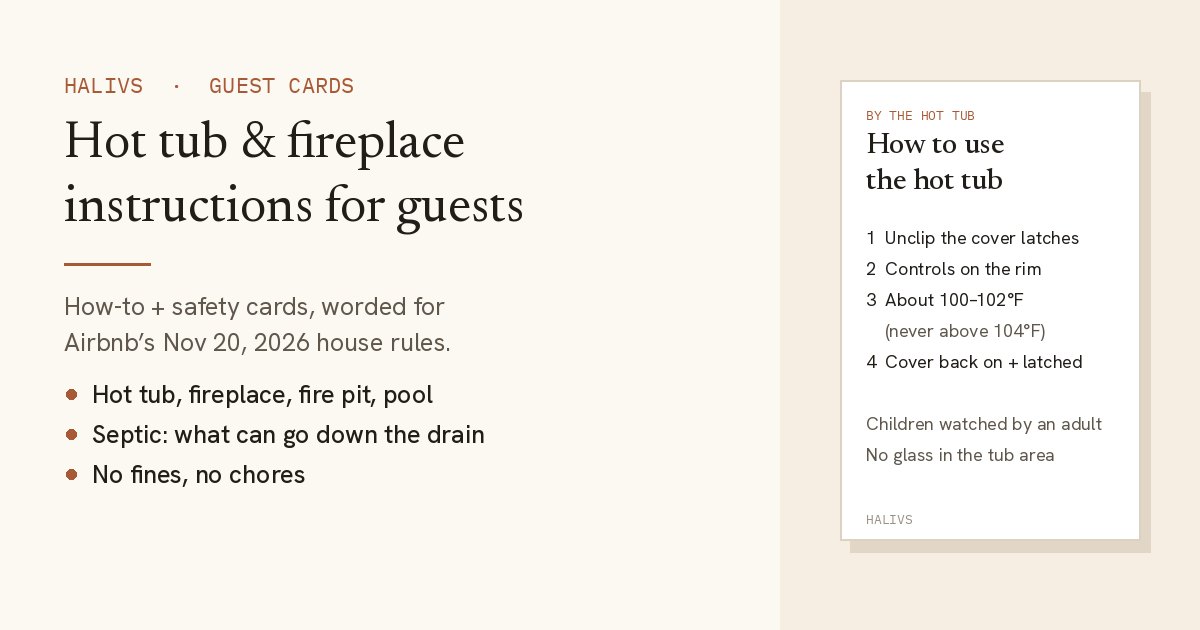
Hot tub how-to card
HOW TO USE THE HOT TUB
1. Unclip the [2] cover latches and fold the cover back onto the [lifter / deck].
2. The control panel is [on the rim, left side]. Press [Jets] for the jets and [Light] for the light.
3. We keep the water at about [100-102]°F. A floating thermometer is in the tub. If it reads above 104°F, please don't get in and message us.
4. Showering first keeps the water cleaner. Towels for the hot tub are [in the basket by the back door].
5. When you're done, put the cover back on and clip both latches.
The pump shut-off switch is [on the wall to the right of the tub]. Questions or something not working: message us in the Airbnb app.
Hot tub safety card
HOT TUB SAFETY INFORMATION
- Please put the cover back on and latch it after each use. (Also in our listing.)
- Children must be watched by an adult in the hot tub area at all times. (Also in our listing.)
- No glass in the hot tub area. Broken glass can't be seen in the water. (Also in our listing.)
- Hot water and alcohol don't mix: drinking makes drowsiness and drowning more likely.
- Health experts say children under 5 shouldn't use hot tubs. If you're pregnant or have a heart or blood-pressure condition, check with your doctor first.
- Take breaks, drink water, and get out if you feel dizzy or sleepy.
- If a drain cover looks loose or broken, stay out and message us.
Where the safety numbers come from: the Consumer Product Safety Commission says hot tub water should never be above 104°F, that 100°F is considered safe for a healthy adult, and that thermostats can be off by as much as four degrees. CPSC also tells owners to use a locked safety cover when the spa isn’t in use, keep drain covers in place and know where the pump shut-off is (CPSC spa safety). The CDC says children under 5 shouldn’t use hot tubs, not to drink alcohol before or during use, and that pregnant people should talk to a healthcare provider first.
What stays with you or your cleaner: chemicals, test strips, the filter and the water. The CDC’s ranges are at least 3 ppm chlorine (or 4–8 ppm bromine) and pH 7.0–7.8. Test between stays and after a big group. Don’t ask guests to add chemicals, skim, or drain the tub. That is maintenance, and it’s exactly the kind of task Airbnb’s policy keeps off guests.
How do you write fireplace and wood stove instructions for guests?
Guests who don’t have a fireplace at home usually get one of three things wrong: the damper, what to burn, and what to do when they go to bed. Cover those, and say where the ashes go: they stay put. Ash removal is cleaner work. Your cleaner moves cooled ashes to a lidded metal container outside, at least 10 feet from the house, which is what the US Fire Administration recommends.
As with the hot tub, the lines marked “also in our listing” need to be in your Additional rules first. The how-to steps and safety facts can stay on the card either way.
Wood fireplace card
HOW TO USE THE WOOD FIREPLACE
1. Open the damper: the handle is [inside, above the opening]. Push it [back] until it stops.
2. Firewood and kindling are [in the rack on the porch]. Fire starters are [in the basket].
3. Build a small fire: two starters, kindling on top, two or three logs. Please burn only the wood provided, not paper, cardboard or trash. (Also in our listing.)
4. Keep the screen closed while the fire is burning (also in our listing), and anything that can burn (blankets, chairs, stockings) at least 3 feet away.
5. Please don't leave a fire burning: let it go out before bed or before you leave the house. (Also in our listing.)
Please leave the ashes in the fireplace; our cleaner removes them.
The carbon monoxide alarm is [in the hallway]. If it sounds, open a window, go outside and call [911].
Wood stove card
HOW TO USE THE WOOD STOVE
1. Open the air control: the lever is [under the door]. Slide it [left] for more air.
2. Light two starters under the kindling, close the door, and add one or two logs once the kindling catches.
3. Keep the stove door closed except when you add wood. The glass and the top get very hot.
4. Keep anything that can burn at least 3 feet from the stove.
5. Let the fire die down before bed or before you go out.
Please leave the ashes in the stove; our cleaner removes them.
If the room smells of smoke, open a window and message us. The CO alarm is [on the wall by the stairs].
Gas fireplace card
HOW TO USE THE GAS FIREPLACE
1. The switch is [on the wall to the right] (or the remote is [in the drawer below the TV]).
2. Press [On]. The flame takes a few seconds to light.
3. The glass gets very hot. Please keep children and pets back from it.
4. Turn it off before bed or before you leave the house.
If you smell gas, don't use any switches: go outside and call [gas company emergency line] and then us.
The carbon monoxide alarm is [in the hallway].
The fire safety lines follow the US Fire Administration’s fireplace and wood stove safety card: keep anything that can burn at least 3 feet away, don’t burn paper, use a screen, keep stove doors closed except when loading, and put the fire out before sleeping or leaving. Its winter fire infographic adds testing carbon monoxide alarms monthly and an annual chimney inspection, both host jobs. Do them before the season, not between guests at the last minute; the winter checklist has the full list.
No-burn days. Some counties and air districts ban wood burning on declared days. If yours does, put that in the listing before booking. It’s a legal reason the fireplace can’t always be used, not a new limit you added. The appeal guide has wording if Airbnb questions it.
What should a fire pit card say?
OUTDOOR FIRE PIT
1. Wood and fire starters are [in the box by the pit]. Please burn only that wood, not paper, trash or anything painted. (Also in our listing.)
2. A bucket of water and a [shovel / hose] are [next to the pit]. Please don't use lighter fluid or gasoline.
3. Keep chairs back from the ring, and children and pets at least 3 feet away.
4. Please don't leave a fire burning (also in our listing): pour water on it, stir, and pour again until it's cool before you go in.
5. Wind carries embers, so a windy day isn't safe for a fire. During a local burn ban it can't be lit by law; [County] posts bans at [website].
Please leave the ashes in the pit; we take care of them.
These lines come from NFPA’s fire pit tips: keep the pit at least 10 feet from anything that can burn, on a level surface that won’t catch fire, burn only clean dry wood, keep children and pets at least 3 feet away, never use gasoline, and keep a hose, bucket or shovel with sand nearby. NFPA also says to check local permit rules. Placement and the bucket are your job; the card just tells guests where things are.
What should pool safety information say?
POOL SAFETY INFORMATION
- Please keep the pool gate closed and latched. (Also in our listing.)
- Children must be watched by an adult in the pool area at all times. (Also in our listing.)
  Pick one adult to be the "water watcher", with no phone or book.
- If a child is missing, check the pool first.
- The life ring and reaching pole are [on the fence by the steps].
- Stay away from the drains. If a drain cover looks loose or broken, stay out and message us.
- No glass in the pool area. (Also in our listing.)
- The pool is about [5 ft] at the deep end, too shallow for diving.
The “water watcher,” “check the pool first,” drain-cover and gate lines all come from Pool Safely, the CPSC campaign, which also recommends a fence at least four feet high with a self-closing, self-latching gate, door alarms and working covers. Those are your setup, not guest jobs. If your pool or hot tub has no gate or lock, Airbnb’s guest safety section lets you disclose “Pool/hot tub without a gate or lock” on the listing (Rental Scale-Up summary). Tick it if it applies.
Pool hours are tricky now. Quiet hours are a standard rule, so you can ask for low noise outside at night. A host-set “pool closes at 9 pm” can read as restricting a listed amenity. If an HOA or building sets pool hours, put that in the listing as their rule.
What can go down the drain on a septic system?
The EPA’s septic guidance is short: only human waste and toilet paper go in the toilet. It lists what never should, including cooking grease, non-flushable wipes, period products, condoms, dental floss, diapers, cigarette butts, coffee grounds, cat litter, paper towels and medicines. Its SepticSmart flyer adds staggering the dishwasher, shower and washing machine rather than running them all at once.
THIS HOME IS ON A SEPTIC SYSTEM
Please flush only toilet paper. (Also in our listing.)
Everything else goes in the lidded bin beside the toilet, including:
"flushable" wipes, baby wipes, paper towels, period products, condoms, dental floss, diapers and cat litter.
In the kitchen: please don't pour cooking grease, oil or coffee grounds down the sink. [The grease jar is under the sink.]
Running the dishwasher, washer and showers at different times is easier on the system.
If a toilet gurgles or drains slowly, please message us right away. Thank you!
Signs alone don’t always work. In an r/airbnb_hosts thread on septic signage, a host describes clogged pipes from personal wipes “despite signs above the toilet” and an explanation in the digital guide, and asks for wording that “really gets attention without sounding crude.” What helps: the same line in the listing, the pre-arrival message and the card; a lidded bin right beside every toilet, so the easy choice is the right one; and naming “flushable” wipes, since guests assume those are fine. Your cleaner empties the bins at turnover. Don’t ask guests to take bathroom trash outside.
What should the pre-arrival message say?
Send it two or three days before check-in. It reminds guests of rules they already agreed to and points to the cards. It doesn’t add anything. Airbnb now offers your house rules as a pre-written quick reply that matches your listing, which is the safest way to send the rules themselves. More message wording is in the message templates.
Hi [Name], we're looking forward to having you on [date].

A few things about the house so you can make the most of it:
- Hot tub: it's ready for you at about [100-102]°F. The how-to card is next to it. As in the listing, please put the cover back on and latch it after each use.
- Fireplace: firewood is [on the porch]. The how-to card is on the mantel. Please leave the ashes; our cleaner takes care of them.
- Septic: as the listing says, the house is on septic, so only toilet paper in the toilets. There's a lidded bin in each bathroom for everything else.

Your house rules are in the Airbnb app under your trip. The welcome book [link] has WiFi, check-in and the rest.
If anything isn't working, message me here and I'll sort it out.
What can’t you say anymore, and what do you say instead?
| Old wording (don’t use) | Why | Say this instead |
|---|---|---|
| “$250 fine if the hot tub cover is left off.” | Fines are out | “Please put the cover back on and latch it after each use.” (in the listing) |
| “Skim the hot tub and check the chemicals before you leave.” | Maintenance is cleaner work | Nothing. You or your pool service do it between stays. |
| “Hot tub closes at 9 pm.” | Restricts a listed amenity | “Quiet hours are [10 pm–8 am]; please keep voices low outside.” (standard rule) |
| “Clean out the fireplace and take the ashes outside.” | Cleaner work, and a fire risk | “Please leave the ashes in the fireplace; our cleaner removes them.” |
| “You will be charged for any plumbing call-out.” | Reads as a penalty | “This home is on septic. Please flush only toilet paper; the bin beside the toilet is for everything else.” |
| New sign: “No fires after 10 pm” (not in the listing) | New rule added after booking | Put it in Additional rules before booking, or drop it. The card can keep the safety steps. |
| “Sign this hot tub waiver at check-in.” | Contracts only in limited cases, uploaded in settings | Ask your insurer. If they require it, upload it under Contracts before booking. |
| “Strip the beds and start the towels before checkout.” | Checkout chores are out | “Please gather used towels in the bathroom.” |
For the full house rules list in the new format, see the Airbnb house rules guide and free PDF. For checkout wording, see the checkout checklist.
What should hosts check before the next guest?
- Read your Additional rules next to every sign in the house. Any instruction a guest could break must be in the listing, word for word. Delete the rest from the sign or move it into the listing.
- Remove fines and chores from signs, the welcome book and saved messages: no amounts, no “you will be charged”, no skimming, draining or ash removal.
- Check the hot tub with your own thermometer (104°F maximum), test the water, check the cover latches and drain covers, and leave a floating thermometer.
- Fireplace and stove: chimney inspected this season, CO and smoke alarms tested, screen in place, a lidded metal ash can outside at least 10 feet from the house for your cleaner.
- Fire pit: at least 10 feet from the house, deck and trees, with a bucket and shovel beside it. Know where your county posts burn bans.
- Pool: gate self-closes and latches, drain covers intact, life ring in place. If there’s no gate or lock, disclose it in the listing’s safety section.
- Septic: “flush only toilet paper” in the listing, a lidded bin beside every toilet, a grease jar under the sink, and the pumping date on your calendar.
- Ask your insurer what they require for a hot tub, pool or wood stove in a rental, and whether they need anything in writing.
- Put the cards where the action happens (next to the tub controls, on the mantel, by the fire pit, above each toilet) and the same text in the welcome book.
- Send the pre-arrival message two or three days before check-in.
If a rule gets flagged after November 20, use the appeal statements for septic, pool and hot tub, and fireplace rules, and attach the proof listed there.
Where should guest cards and the welcome book go?
Put each card where the guest is standing when they need it: hot tub cards on the tub rail or the door out to it, the fireplace card on the mantel, the fire pit card in the wood box lid, septic cards above the toilet tank. A 5×7 card in a cheap frame or a plastic sleeve is easy to read and survives steam. Keep the same wording in your welcome book, so guests reading on the sofa see it before they head out to the tub.
The free Halivs hot tub card is the how-to and safety card above as a printable 5×7. The $5 Hot Tub, Fireplace & Fire Pit Guest Cards add how-to and safety cards for a wood fireplace, a gas fireplace and a fire pit, plus a blank card for your pool or septic text, as a PDF and an editable file that opens in free Canva, PowerPoint or Google Slides. Cabins usually need more than cards: firewood, well water, wildlife trash and the drive in. The cabin welcome book guide covers those pages, and the Halivs welcome book ($12 printable or $17 editable in Canva, with a phone edition) holds them in one place. If you share the book by phone, the digital welcome book guide explains the QR sign.
Questions hosts ask
Can I still have hot tub rules on Airbnb after November 20, 2026?
Yes, if they are reasonable and in the Additional rules section of your listing before the guest books. Safety rules such as keeping the cover latched, no glass in the hot tub area and adults watching children are the kind Airbnb can treat as reasonable. What you can’t do is add a new rule by sign or message after booking, charge a fine, or ask guests to clean, skim or drain the tub.
Is a hot tub sign in the home a new house rule?
It depends on what it says. A sign with how-to steps (where the controls are, how to open the cover) and safety information (the temperature, no diving) is fine. A sign that tells guests to do something they did not see in the listing can count as a new rule. Airbnb’s policy says new rules can’t be communicated after booking, including by signs in the home.
What temperature should an Airbnb hot tub be?
The US Consumer Product Safety Commission says hot tub water should never be above 104°F (40°C), and that 100°F is considered safe for a healthy adult. It also warns that thermostats can be off by as much as four degrees, so check the water with a separate thermometer and leave one in the tub for guests.
Can I ask Airbnb guests to clean out the fireplace?
No. Removing ashes is cleaner work, and Airbnb’s new policy does not allow tasks a cleaner would usually do. Ask guests to leave the ashes in the fireplace or stove, and have your cleaner move cooled ashes to a lidded metal container outside, at least 10 feet from the house, as the US Fire Administration recommends.
Can I charge a fee if a guest flushes wipes on a septic system?
Not as a fine. Airbnb says hosts generally can’t impose fines or penalties. You can put “flush only toilet paper” in your Additional rules, provide a lidded bin beside each toilet, and repeat the wording on a small card. If a guest causes real damage, that goes through Airbnb’s damage process, not a house-rule fine.
Can I close the hot tub or pool at night?
Be careful. Airbnb’s policy says hosts generally can’t restrict access to a feature advertised in the listing. Quiet hours are one of the seven standard rules, so you can ask for low noise outdoors at night. If an HOA or local law limits pool or hot tub hours, say so in the listing before booking; that is a reason, not your own restriction. This is not legal advice.
Do I need guests to sign a hot tub waiver?
Separate contracts are now only allowed for limited reasons, such as legal or insurance requirements, HOA rules, monthly stays and some optional amenities, and they have to be uploaded under Contracts in your listing settings. Ask your insurer what they require. A clear listing, a pre-arrival message and a safety card by the tub are the main tools for everyone else.
Sources: Airbnb house rules policy (Help Center 4168), Airbnb Resource Center: important changes to house rules, Rental Scale-Up: Airbnb safety updates, CPSC: hot tub temperatures, CPSC: pools, spas and hot tubs, CDC: staying healthy in hot tubs, Pool Safely safety tips, US Fire Administration: fireplace and wood stove safety, US Fire Administration: winter fires, NFPA: fire pit and outdoor fire tips, EPA: how to care for your septic system, EPA SepticSmart do’s and don’ts, Airbnb Community Center thread, r/airbnb_hosts: septic signage, r/airbnb_hosts: hot tub disclaimer and rules. Halivs makes printable templates for hosts; it is not a law firm or a safety inspector, and this page is not legal advice.